BackEpisode 01
Episode 01 · Season 01 · Apr 6, 2026
What If the Self Isn’t Something to Find?
GuestMichael Puett
AffiliationChinese history and anthropology, Harvard University
HostSimi
Episode01 / S01
ReleasedApr 6, 2026

Michael PuettChinese history and anthropology, Harvard University

SimiHost, SPS Conversations
0:04
Simi
Today we’re speaking with Professor Michael Puett, who teaches Chinese history and anthropology at Harvard University. He’s the author of four incredible books, and personally my Chinese historiography professor during my fall semester here at Harvard. This conversation is part of the Society for Perception Studies speaker series, where we explore the ideas that change how we see the world and celebrate the people, especially the educators, who make that shift possible. Thank you so much for being here, Michael.
0:32
Puett
It’s an honor to be here. Thank you so much for all you’re doing.
1:01
Simi
I actually took your class not because I had a specific interest in China, but because I thought encountering a different worldview might help inform the learning architecture I’ve been building in my master’s work. And I especially love that it was a historiography course — not just about historical events, but how the story is told and the ideas that emerge from that. Encountering history from that perspective for the first time really changed how I think about how knowledge itself is constructed. Your classes have clearly resonated at Harvard — you teach one of the top three most popular courses in the entire university. Hundreds of students fill lecture halls to learn about Chinese philosophy, and a lot of them have said the class was life-changing. Why do you think so many students are drawn to it?
1:50
Puett
Part of what is so exciting about these Chinese philosophers is they are all about asking: why is it that we fall into patterns that can define our entire existence — define what we see and don’t see in the world, the relationships we form — and how can we change those? How can we improve the relationships? How can we learn to see more of the world? How can we learn to interact in the world more effectively? And they’re incredibly practical. It’s an incredible vision of how, through training and cultivation, we can develop much more extraordinary possibilities than we tend, sadly, to do in our usual daily existence.
2:34
Simi
When Haze and I came to your office hours and asked what sparked your interest in studying China, you told us a story we loved, about how you grew up in Nashville near a library. Would you mind sharing it again?
2:48
Puett
Absolutely. I was always this voracious reader growing up, mainly novels and poetry, which I still absolutely love. But at a certain point I realized, being a native English speaker, I was reading things in English — which was wonderful, but I wanted to learn about the rest of the world. So I decided to start going to the local library and literally going from section to section — it was arranged by geographical area — learning the world. And it was extraordinary. Truly life-changing. I fell in love with all of the literatures, philosophies, ideas, religions from around the world, decided to start learning other languages, and I’ve ended up continuing to fall in love with these ideas — and have ultimately become a teacher to try to give my students a sense of just the extraordinary richness of these philosophies.
3:38
Simi
I see that curiosity reflected in your teaching style — how open you are to your students and their questions and perspectives. And I think it’s so important that you took yourself out of the predominantly Western canon we all grow up in and exposed yourself to alternate ways of thinking and seeing. For me that raises a bigger question about how we understand other cultures. In the class I took with you, we studied the giants of Western thought — Marx, Weber, Durkheim — and they all tried to explain China. But it seemed like China became a way of projecting their own Western fears and anxieties: of stagnation, of tradition. What do we actually gain from studying a culture through those perspectives?
4:31
Puett
I think you’re exactly right. When you read the great Western thinkers of the nineteenth and twentieth centuries — thinkers who largely define how many people in America and Europe now commonsensically think about the world — it is horrifying, despite their brilliance, to see the ways they read other cultures. And I think it’s helpful to go back and read them, because when we casually make statements about so-called non-Western societies, we often don’t realize those statements came out of horrible stereotypes that arose largely in nineteenth-century Europe, at the height of imperialism. It’s very helpful for students to see that, hopefully be horrified by it, and then ask: what if we actually studied these religions and philosophies themselves? What if we devoted ourselves to trying to learn from other cultures, as opposed to imposing our values upon them?
5:29
Simi
I didn’t realize until your class how much of our knowledge is based in nineteenth-century imperial expansion. And even learning how we misread China — we could ask what it would be like to understand China on its own terms. Is it actually possible at all to understand another country, or other people, on their own terms, without our own inherited frameworks?
5:55
Puett
I think you’re absolutely right that the goal is to understand other cultures on their own terms. I don’t think it’s ever going to be purely possible to do so. But instead of doing what we tend to do — simply imposing our values on other cultures — imagine if we trained ourselves to honestly learn from other cultures, in which case we’re thinking of it more as a dialogue. When you see different ideas, different values — or sometimes surprisingly common ideas, worked out in very different ways and practices — how can we learn from that? Now, that may sound absurdly utopian. At the same time, I’ve found in the classroom it actually is possible. In classrooms in America, virtually everything assigned is based on Western frameworks, largely from the nineteenth-century imperial period. Yet if you actually assign works — even granted, in translation — students become incredibly excited by these new ideas. They start bringing them into their daily practices, and within two to three months of a semester you can see the excitement. If that’s true in two to three months, imagine what it can mean over the course of a lifetime. So: will we ever totally understand a given culture purely on its terms? No. But can we do the dialogic work of learning across cultures? Absolutely yes.
7:51
Simi
In your book The Path, you draw on these ancient Chinese thinkers to reframe how we approach life, and something that comes up is identity — the Western concept of finding yourself, as if there’s some fixed self beneath all the layers that we have to somehow discover. Do you think that’s a productive endeavor, this pursuit of finding yourself?
8:16
Puett
I think it can be an incredibly dangerous endeavor. Now, let me immediately say there can be good sides to it. The good sides are the obvious ones: if I look within and find my true self, that’s a basis for questioning social conventions. Sure — there’s a liberatory side to that. But I also think that way of thinking, which is the common way in America, is incredibly dangerous. Because oftentimes what we’re really doing when we say “I should look within, find myself, love and embrace what I am — my good sides, my bad sides, because it’s just me” — what we’re really saying is: I will love what I currently claim to be. And what if, going back to Chinese philosophy, a lot of what I am is just based on patterns — oftentimes very negative and reductive patterns I’ve fallen into? Then I’m telling myself I should love and embrace a bunch of patterns I fell into from bad habits at a very young age. Which of course would be absurd. If I have bad habits — and assuredly I do — surely I should try to break them, train myself, grow, and become something greater than I currently am. That’s part of what I love about Chinese philosophy: the focus is on training ourselves to be something incomparably greater than we currently are. And the key is, it’s not focused on me. It’s focused on how, through building extraordinary relationships, I can — with others — build worlds where we all can flourish.
10:07
Simi
So who we are right now is technically just a mess of ruts and habits that we’ve fallen into, that we think is ourselves.
10:19
Puett
Exactly. And these habits can become so naturalized that we don’t even see them anymore. They become invisible.
10:26
Simi
What would you say is the mechanism for making these habits visible? Is this where ritual comes in?
10:35
Puett
Yes. One of the things the Chinese philosophers strongly emphasize is ritual. In America, you mention the word ritual and people immediately think: that’s terrible, ritual tells me what to do, and I want to be following my true self. The reason Chinese philosophers emphasize ritual is precisely because they say: if we are capable of becoming something far greater than a bunch of bad habits we’ve fallen into, it’s in ritual where we do the training work. You need to be developing daily rituals where you are constantly breaking your perspective, training yourself, opening your eyes, breaking the habitual ways we operate in the world. It’s through that training that you begin to see these horrible habits, begin to develop extraordinary relationships, and begin to really see the world.
11:32
Simi
In class we talked about Max Weber’s iron cage — how life can feel like this endless loop of working and achieving without really knowing why. He traces it back to a religious anxiety in early Protestant Europe, where people didn’t know if they were chosen by God, and there wasn’t a way to find out. So they kept working and working, in hopes that their discipline might somehow mean they were among the chosen. Do you feel like there’s some modern version of that anxiety playing out today?
12:06
Puett
I do. Weber’s reading is profoundly onto something. We often think the danger of a modern capitalist world is that we’re endlessly trying to gain wealth. Part of the power of Weber is that he noticed our anxieties go way beyond any actual possible acquisition of wealth. His argument is that the world of anxieties we live in comes from these early Calvinist ideas: we’re predestined for heaven or hell, there is nothing we can do, it’s already determined. And it creates this anxiety where, if I just endlessly work all the time, presumably that must mean I’m one of the chosen. So you’re working way beyond any practical reason to be working. He was absolutely right about that. It creates, as he said, this iron cage of modernity — a total rat race, a world unto itself, even when there are no practical benefits gained from it.
13:20
Simi
So worldly achievement is a kind of secularized version of that anxiety. But I wonder — if you orient yourself around bettering yourself rather than proving yourself, whether that whole anxiety structure collapses. At that point you would be improving yourself instead of proving yourself.
14:02
Puett
I love that phrasing, and yes — if we focus on improving ourselves rather than proving ourselves, I think it changes everything. Part of what’s intriguing in the Chinese tradition — and I think this is absolutely right in practice — is that once you start training yourself to really connect with others, as opposed to trying to prove yourself in terms of what others think of you, you immediately start developing incomparably stronger connections, in which we and those around us are truly growing. And it quickly begins to build on itself — this sense of creating a greater world.
14:40
Simi
That reminds me of something that came up the other day in Professor Unger’s class — this idea of vitality. It was funny, because he was speaking to us as if we all had the same definition of it: the modern conception, the nineteenth-century Romantic sort of loud breaking out of structure. And it made me think about how, etymologically, vitality just means life force. In my religious tradition, life force is directly connected to the heart and the work of purifying it. Those feel like opposite directions to me. One is looking outside yourself to feel alive — even deifying your desires, which could give you the illusion of life force. The other is quietly cultivating something within. How do you think about that tension — between borrowing aliveness from relationships, work, whatever feels most immediate, and treating it as something we can actually grow from inside?
15:56
Puett
I love the contrast you’re drawing, and just to underline it: yes, in America in particular we tend to think of vitality in exactly the way you mentioned — me as an individual grabbing more for myself, breaking from social conventions, and somehow that means I’m more alive, more vital. It’s all about me and my personal greatness. To even call that a low-level form of vitality might be overly polite — I think it actually destroys your energies. And like you, I’m very moved that so many other traditions in the world say, on the contrary: energy is all about the training and cultivation that allows us to energize, literally, the world around us. In the Chinese tradition they’ll say: think of spirits as purely refined energies, the highest being the most highly refined. What we are doing is training ourselves, cultivating ourselves, to become in a very literal sense more spiritual — our energies become more refined. And with that training, it’s all about connection. It’s not about “look at me, look how powerful I am.” It’s about training these energies and then truly connecting with others and with a larger world.
17:20
Simi
It also makes me think about religion. The modern definition of religion is very connected to identity — something you have to defend. And when you look at it as an identity, you miss the beauty of it as a practice. Do you think that shift from identity to practice changes how we should understand religion?
17:46
Puett
I agree completely. So often now we think of religion as identity: I am X as opposed to Y. And it has all the dangers you’ve mentioned. Here too there is a history. In much of the world, what we could correctly refer to as religious practices weren’t done in this form of “I am X as opposed to Y, I am right, you are wrong.” They were practices. And the more we can focus on the practices, the more we can truly open up the power of these traditions. Once you’re focusing on practices, it allows — this is going to strain English — the practice form of dialogue we were discussing before. A lot of these ritual practices work across cultures, and they’re getting at very comparable sets of issues. If you’re not thinking “this religion versus that religion” but thinking about practices through which we can grow, it changes absolutely everything.
18:53
Simi
In ancient China, when you talk about ritual, there was one that really struck me — the role reversal, the no blushing. Do you mind explaining that?
19:05
Puett
Absolutely. It’s a very telling example of the way ritual is being thought of in early China. In the ritual, it’s a father and a son — although it can be done with any family member, any friend, with gods, with other humans, with animals. The key is: when they walk into the ritual space, they cannot blush, because they literally become a different person. The father becomes the son of his own son. The son becomes the father of his own father. Each is forced to relate to the other from the precise opposite subject position they would occupy outside the ritual. And the idea of being forced to do this role reversal on a regular basis means: instead of the usual patterns that can sadly set in across generations in a family, how do you break those dynamics? You literally become the other person. You literally see the world from the opposite perspective. You relate to the person with whom you often have a very tension-filled relationship — but from the exact opposite subject position. The argument is — and I think in practice this is absolutely right — if you’re doing this regularly, very quickly you see the degree to which the world outside the ritual is just a bunch of bad habits we’ve fallen into. And once you sense that, and sense the degree to which it is defining this relationship, that is the degree to which you finally begin changing it.
20:39
Simi
I love that idea of putting yourself in somebody else’s shoes, but in a sacred space. Maybe it’s been psychologized today — there are different words for it, like cognitive defusion. But I love the idea that something could be one thing, and the way you look at it could be very different from the way somebody else looks at it — and then deliberately putting yourself in positions where you see that same unchanging thing change, just through the way we see.
21:10
Puett
Precisely. And I love the way you phrase it. When we think of things like this — cognitively trying to understand the world from other perspectives — that’s obviously important, but we’re thinking about it purely as: me, Michael, trying to understand the world from the point of view of Houman. That’s good to a certain level. But this, as you said, goes far more. In a ritual context, I literally become — to stick with that example — Houman, in my embodied state. It’s not just me thinking this way, which probably means I’m not really taking his perspective whatsoever. I am embodied, relating to the person who was Houman outside the ritual, and I am truly gaining a sense of that perspective in a fully embodied sense. It’s so much more moving than simply the cognitive “I’ll see the world from his view.”
22:06
Simi
Since I’ve taken your class, I feel like I’ve developed more rituals to be more of a noticer, more connected to myself in a way that breaks the structures I’ve inherited. One of those, which we talked about before the interview, was prayer — coming back to center and realizing that we are small compared to this universe, and even in that realization there’s so much gratitude. I think gratitude as a lens could be very useful — it could be a perceptual position. I constantly try to create new rituals that break me out of my patterns, but I think the important thing is noticing the patterns. Do you have any rituals?
22:56
Puett
Like you, I try to do them constantly. It is striking — and I mean this literally — when I first started reading these classical Chinese philosophical texts, I realized the degree to which, when I would walk to the bus as a kid, or now when I walk to school to teach, it is amazing how little of the world we actually see. It is amazing, in our daily relationships, the degree to which we’re really not connecting to those around us whatsoever. Once you begin to sense that, and once you begin these rituals that are all about training you to really connect and really see the world, it changes everything. So I do this constantly. If I’m walking to school in the morning, I’m training myself to actively see the world. When I’m interacting with people, I’m training myself to actively do so. I think prayer is a wonderful example, where you’re developing, as you said, the disposition of gratitude — which is something we’d like to say we feel all the time, but we really don’t. You are actively cultivating it. And once you’re cultivating these dispositions through ritual, they slowly become part of your everyday existence. Over the course of the training you begin truly connecting, seeing the world, feeling gratitude — as opposed to simply walking around, as we mostly do, sort of unconscious.
24:33
Simi
I feel that even putting myself in your Chinese historiography class, or going into a poetry class — which I’m taking this semester and wouldn’t usually have taken — is exposing myself to new ways of seeing. In close reading, it feels like nothing is beneath the attention of a poet. You have to extract meaning and come at it through a posture of humility as a perceptual lens, where you’re not sure where meaning might appear — instead of leading with a posture of authority, which we’re sometimes encouraged to do: have a position, defend it. Humility as a perceptual lens is so much more generative.
25:19
Puett
That’s a beautiful way of putting it, and I love your image of reading as a ritual. We’re often trained, when we read — a classroom example — to flip through a text quickly, find my line on it, so I can say this author is wrong because of X, raise my hand, prove my authority, and my work is done. On the contrary, if we think of reading as a ritual — and poetry is a perfect example — to read poetry, we are training ourselves to focus on every word, because it’s written by a poet who did that. It takes reading and rereading. Every new reading, we see depths we didn’t see before. It forces one not to come in as the authority, but to be the figure who is listening and learning from the piece. Poetry really pushes that upon us — if you go in with the standard authoritative mode of reading, you literally cannot make sense of a poem.
26:31
Simi
It feels like everything we’ve talked about comes back to this idea: to change how we live, we have to change how we see. And I really like that in your teaching, change doesn’t have to come from big shifts — it comes from small, daily, ritualistic shifts: changing how you notice, changing how you respond, changing how you reflect. Breaking out of the patterns we fall into. Even seeing life as a process of transformation rather than this teleological thing where we have to achieve certain goals. Thank you so much for making all these complex ideas so accessible and easy to apply.
27:08
Puett
But thank you for all that you are doing. Truly — going back to the classroom, you’ve clearly developed a practice wherein you sense the discussion going on and you sense perfectly how to raise a comment, how to raise a question that opens up the entire discussion. That’s a sign of someone who is actively putting this into practice. So thank you for what you’re doing in the classroom, thank you for these discussions you’re organizing, and thank you for all the pedagogical work you are doing for the world.
27:40
Simi
Thank you for being our first Society for Perception Studies speaker.
27:45
Puett
It is truly an honor. And the good news is, by starting with me, there’s no place to go but up.
Discuss this episode
0 commentsNothing written yet. The first comment sets the tone.
Recommended books
02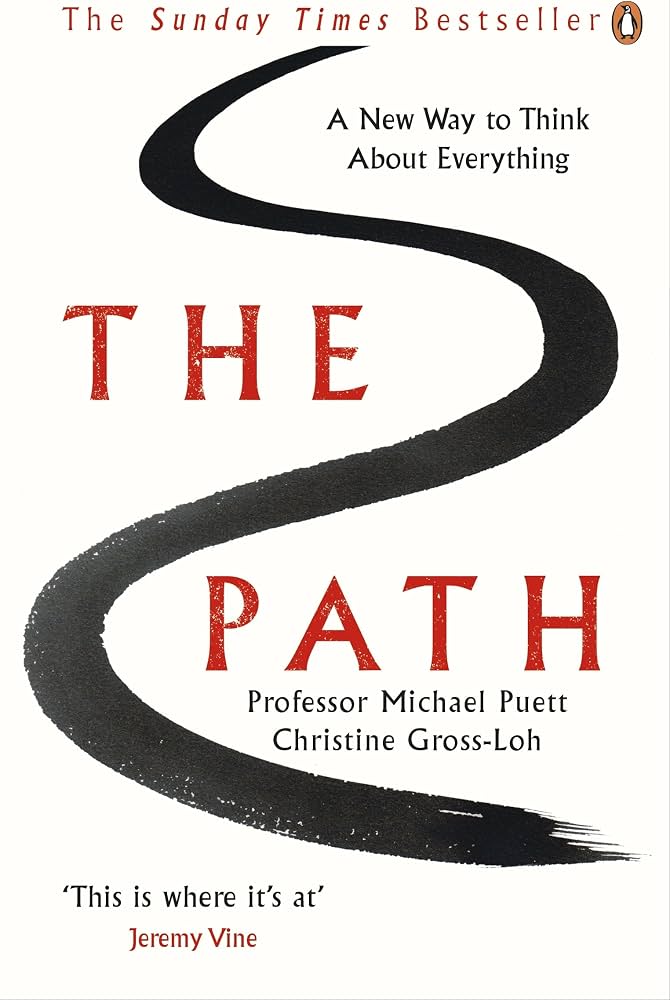 BookThe PathMichael Puett & Christine Gross-Loh, 2016Chinese philosophers on why the true self is a trap and training is the way out.
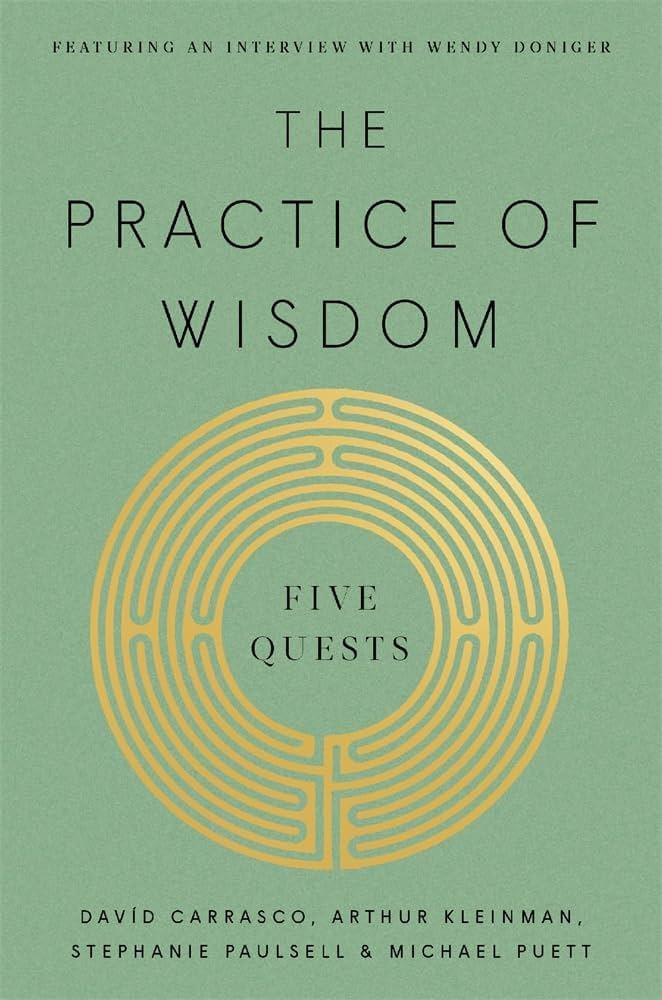 BookThe Practice of WisdomDavíd Carrasco, Arthur Kleinman, Stephanie Paulsell & Michael Puett, 2026Wisdom as a practice, not a possession. Five quests, with an interview with Wendy Doniger.